
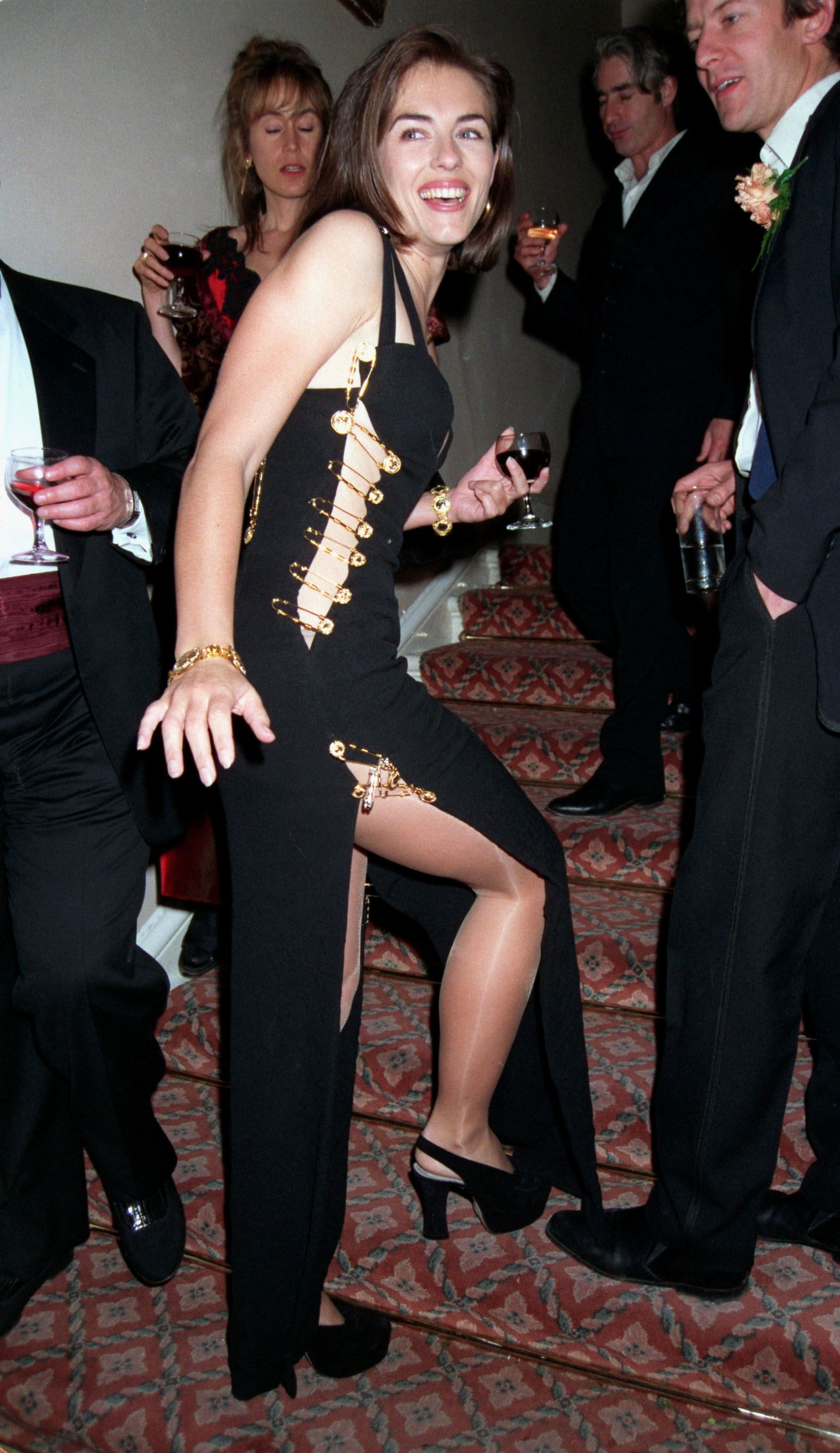
Sometimes a single outfit can completely overshadow the event it was worn to. Elizabeth Hurley's black Versace dress, held together by enormous gold safety pins, was worn to the premiere of a film she wasn't even part of. Yet decades later, the dress remains far more recognizable than the premiere itself. Widely known as "THAT Dress," the 1994 look transformed Hurley from a relatively unknown actress into an international fashion name almost overnight and helped establish Gianni Versace's reputation for unapologetically provocative glamour.
The Night That Made Elizabeth Hurley Famous
Hurley wore the now-famous dress in May 1994 to the London premiere of Four Weddings and a Funeral, accompanying her then-boyfriend Hugh Grant. The romantic comedy became a major international success, earning an Academy Award nomination for Best Picture and eventually becoming one of the most successful British films of its era. But on the red carpet that night, much of the attention moved away from the movie and toward the woman standing beside its leading man.
Hurley was only 28 and was not yet a household name. She had been dating Grant for around seven years after the two met while working on the 1988 film Rowing with the Wind. Grant was already gaining recognition as an actor, but Hurley had not yet experienced the kind of global media attention that accompanies a major Hollywood premiere.
That changed almost immediately. Photographers crowded around Hurley as she posed in the black dress, while newspapers and magazines around the world began reproducing photographs of her daring outfit. The safety-pin design became the visual story of the evening, turning Hurley into an international fashion celebrity even though she had arrived primarily as Grant's date.

Example: How Rejection Led to One of Fashion's Most Famous Dresses
One of the most interesting details about the story is that Hurley didn't have a long-standing relationship with Versace when she wore the dress. In fact, she has said that she barely knew the fashion house at the time.
Because Hurley was still relatively unknown, she initially struggled to borrow a designer outfit for the premiere. Several fashion houses reportedly turned her down when she contacted them about dressing her for the event. The situation was particularly awkward because she and Grant had been told they could borrow designer clothing for the premiere, but Hurley had very few connections within the fashion industry.
Eventually, she contacted the Versace store on London's Old Bond Street. There she met Dean Aslett, who was heading the womenswear operation at the store. Aslett agreed to help her, effectively giving an unknown actress access to one of the most attention-grabbing designs in Versace's collection.
Hurley later recalled that she had never even heard of Versace before the experience. In an amusing twist, she thanked Aslett by giving him four tickets to the premiere. That small decision ultimately became the beginning of one of the most famous celebrity-and-designer associations of the 1990s.
Who Designed Elizabeth Hurley's Safety-Pin Dress?
The dress was created by Italian designer Gianni Versace and originally appeared as part of his Spring/Summer 1994 collection. It was not designed specifically for Hurley or the Four Weddings and a Funeral premiere. Instead, she wore an existing runway design that had already established the provocative aesthetic Versace was pursuing at the time.
The collection explored the relationship between clothing and the body, using dramatic openings, cutouts and metal hardware to make traditionally glamorous eveningwear feel much more rebellious.
The safety pins were particularly important to the collection's visual language. Rather than hiding seams or treating fasteners as purely functional details, Versace made them the centerpiece of the garments. Oversized pins became decorative objects while simultaneously holding sections of fabric together.

What Inspired the Safety-Pin Design?
Versace's approach drew from several cultural references. The safety pins were associated with the rebellious energy of punk fashion, while the wraparound construction of the garments reflected elements of the Indian sari.
The runway presentation reportedly increased the drama progressively. Early outfits featured relatively restrained tailoring and smaller fastening details. As the show continued, the pins became larger and more prominent, while the garments revealed increasingly large areas of the body.
Hurley's particular dress captured that idea perfectly. The black fabric was dramatically cut, with deep openings secured by large gold and silver-tone safety pins featuring Versace's distinctive Medusa-head detailing. The pins weren't merely decorative additions. They appeared to be the very things keeping the dress together, creating the illusion that the garment could fall apart at any moment.
Why the Dress Looked More Dangerous Than It Actually Was
Photographs made the dress appear almost impossibly precarious. With large sections of skin exposed and metal pins visibly connecting the fabric, it was easy for viewers to assume Hurley had taken a considerable physical risk simply by walking onto the red carpet.
Hurley has repeatedly explained that the reality was quite different. Speaking about the dress years later, she emphasized that couture garments are carefully constructed to fit and support the body even when their appearance suggests otherwise.
The dress was fitted specifically enough that the safety pins were not simply dangling pieces of hardware holding loose fabric together. Hurley has described it as surprisingly secure and joked that it was much more comfortable and practical than its photographs suggested.
That distinction is important to the dress's legacy. Its impact came partly from the illusion of danger. The audience saw huge pins, exposed skin and dramatic openings, but the actual garment was a carefully engineered piece of fashion rather than a precarious collection of fabric and fasteners.
Example: The Dress Was Almost More Famous Than the Woman Wearing It
The strongest evidence of the dress's impact can be seen in how quickly it became identified simply as "THAT Dress." Hurley's name and the Versace label eventually became attached to the look, but the garment developed an identity of its own.
For someone who was still relatively unknown internationally, this was extraordinary. A single red carpet appearance gave Hurley a level of visibility that many actors spend years trying to achieve. Magazine covers, newspaper articles and television segments repeatedly focused on the dress, making its safety-pin construction one of the most recognizable fashion images of the 1990s.
It also demonstrated the growing power of celebrity red carpet dressing. A premiere was no longer simply an occasion for actors to promote a movie. The clothing itself could become part of the entertainment, generating headlines independently of the film.
Gianni Versace's Vision of the Female Form
The dress perfectly represented Versace's design philosophy during the early 1990s. Rather than attempting to conceal the body beneath traditional eveningwear, Versace treated the body as an essential part of the design.
Cutouts, plunging openings, metallic hardware and body-conscious construction appeared repeatedly in his collections. The designer understood that a dress could create drama not only through fabric, color and silhouette but also through what it deliberately left uncovered.
That approach helped distinguish Versace from more restrained luxury houses of the period. His clothing was designed to be noticed. It photographed dramatically, moved differently on the body and often encouraged the wearer to become part of the visual spectacle.
The Influence on Red Carpet Fashion
Hurley's appearance arrived at an important moment in celebrity fashion. Red carpet dressing was becoming increasingly important to the entertainment industry, while designers were discovering that a particularly daring celebrity appearance could generate enormous publicity for a fashion house.
"THAT Dress" became an early example of this phenomenon. Its enormous media coverage reinforced the idea that celebrities could use fashion to create an identity, while designers could use celebrities to introduce runway designs to millions of people who would never attend a fashion show.
The look also helped normalize increasingly revealing red carpet silhouettes. Later celebrity fashion moments would push the idea even further, from Jennifer Lopez's plunging green Versace gown at the 2000 Grammys to the sheer and highly revealing gowns that became common on major award-show red carpets.
Elizabeth Hurley and Versace After the Famous Dress
The safety-pin dress became so closely associated with Hurley that it effectively established a long-running relationship between the actress and the Versace aesthetic. The look helped position her as someone who could carry dramatic fashion with confidence rather than simply appearing as an actor accompanying another celebrity.
Interestingly, Hurley has remained remarkably relaxed about the dress's extraordinary afterlife. She has acknowledged that she only wore the original gown once before returning it to Versace, yet the garment continued to appear in exhibitions, retrospectives and fashion coverage long after that single evening.
Hurley has also revisited the spirit of the look throughout her career, demonstrating that the confidence and body-conscious glamour associated with the original dress became part of her broader public image.
Where Is the Original Dress Now?
Unlike many celebrity outfits that disappear into private collections, Hurley's safety-pin dress has continued to be treated as an important piece of fashion history. After Hurley returned it to Versace, the garment became part of the fashion house's broader archival legacy.
Its continued appearances in fashion retrospectives demonstrate how unusual its transformation has been. What began as a runway garment worn by an actress who was relatively unknown became one of the defining celebrity-fashion images of the 1990s.
Why "THAT Dress" Still Matters
More than 30 years later, the safety-pin dress remains important because it represents several changes happening simultaneously in celebrity culture and fashion.
First, it demonstrated the enormous publicity value of a memorable red carpet outfit. Second, it showed how a designer's runway concept could become much more culturally powerful when attached to the right celebrity at the right moment. And finally, it helped establish the idea that red carpet clothing could be provocative enough to become news in its own right.
There is also something unusually accidental about Hurley's story. She wasn't a global superstar carefully planning an image-defining fashion statement. She was a relatively unknown actress who struggled to borrow a dress, eventually received a favor from a fashion executive, and happened to wear one of the most visually striking designs of the season to an enormously photographed premiere.
That combination of chance, celebrity, design and timing is precisely what makes "THAT Dress" so difficult to replicate. Fashion can create a spectacular garment, but it cannot guarantee that the world will remember it. In Hurley's case, everything happened at exactly the right moment.
FAQs
Who designed Elizabeth Hurley's safety-pin dress?
The dress was designed by Italian fashion designer Gianni Versace and originally appeared as part of his Spring/Summer 1994 collection.
When did Elizabeth Hurley wear the Versace safety-pin dress?
Hurley wore the dress in May 1994 to the London premiere of Four Weddings and a Funeral, where she accompanied her then-boyfriend Hugh Grant.
How did Elizabeth Hurley get the famous Versace dress?
Hurley had difficulty borrowing a designer outfit because she was relatively unknown at the time. She eventually contacted the Versace store on London's Old Bond Street, where Dean Aslett helped arrange the dress for her.
Why does Elizabeth Hurley's dress have safety pins?
The oversized safety pins were an intentional part of Gianni Versace's design. The collection drew inspiration from punk fashion and incorporated the pins as both functional fasteners and dramatic decorative elements.
Did Elizabeth Hurley know the dress would become famous?
No. The enormous reaction to the outfit was not something Hurley could have predicted. The dress generated intense international publicity after she wore it to the premiere and became closely associated with her career.
Did Elizabeth Hurley only wear the dress once?
Yes. Hurley has said that she wore the original dress only once, at the 1994 premiere, before returning it to Versace the following day.
Was the Versace safety-pin dress actually safe to wear?
Despite its daring appearance, Hurley has explained that the dress was carefully constructed and surprisingly secure. The dramatic safety pins were part of the garment's deliberate design rather than a sign that it was literally falling apart.
Why is Elizabeth Hurley's Versace dress called "THAT Dress"?
The nickname reflects how completely the outfit dominated coverage of the 1994 premiere. Rather than being remembered simply as another celebrity gown, it became one of the most recognizable fashion images of the decade.



 Posts


No comments:
Post a Comment