
It lasted only a few seconds on screen, but the image it produced became one of the most reproduced photographs of the 20th century. Marilyn Monroe's white pleated dress from The Seven Year Itch didn't just define a single movie scene. It became permanent shorthand for Monroe herself, endlessly referenced, parodied, photographed, and imitated in the decades since.
Marilyn Monroe's White Subway Dress: The Full Story
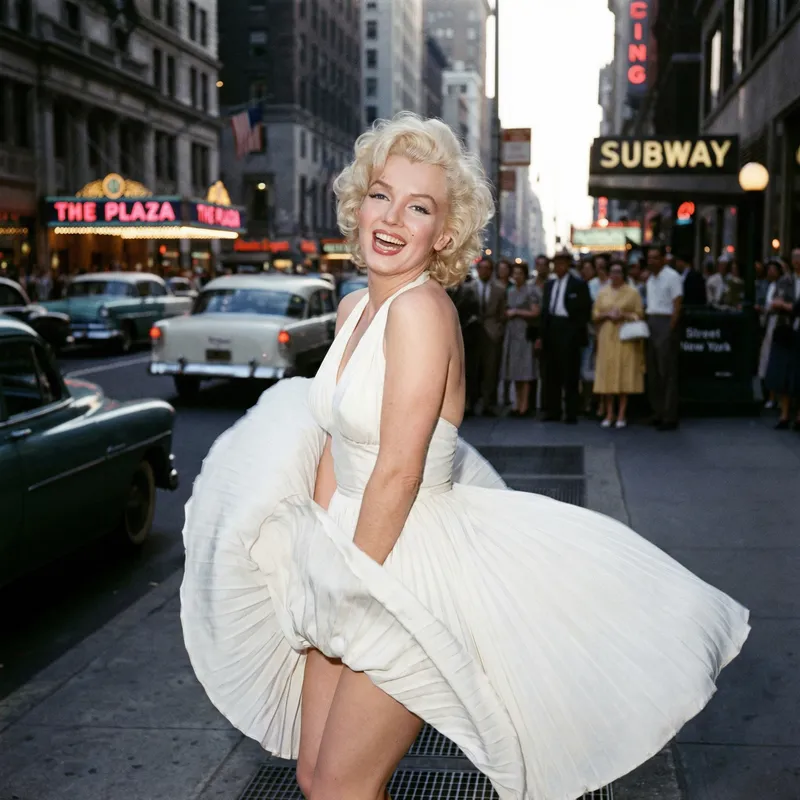
The scene is so famous that the image of Monroe standing over a subway grate has become recognizable even to people who have never watched the movie. The flying skirt, platinum-blonde hair, white heels, and Monroe's playful expression combined to create an image that perfectly captured the star's carefully cultivated public persona.
But there is considerably more to the dress than the famous photograph suggests. The garment was engineered specifically for movement, its designer William Travilla had an unexpectedly complicated relationship with it, and the original filming of the scene was far more chaotic than the finished movie would suggest.
Here's the full story behind Marilyn Monroe's white subway dress, how it was designed, what happened when the scene was filmed, why the dress became controversial, and where the surviving versions ended up.
The Scene That Made It Famous
The dress appears in Billy Wilder's 1955 romantic comedy The Seven Year Itch, in a sequence where Monroe's character, credited simply as "The Girl," exits a movie theater on Lexington Avenue with her costar Tom Ewell, who plays Richard Sherman.
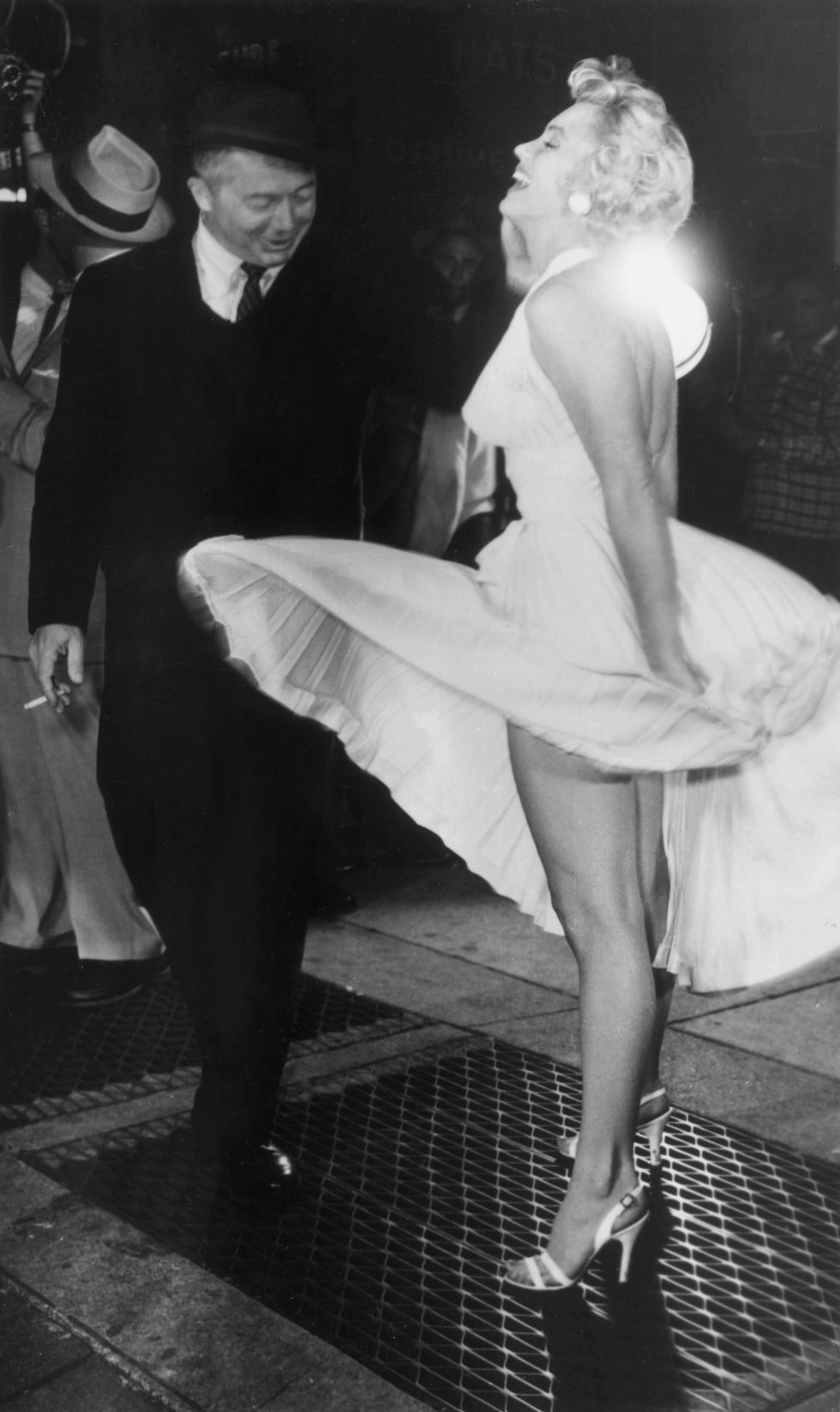
As the pair pause on the sidewalk, they feel a subway train passing beneath a street grate. Monroe's character notices the breeze coming upward and playfully steps onto the grate. She asks, "Ooh, do you feel the breeze from the subway?" before the air sends her skirt billowing upward.
The moment was designed as a piece of visual comedy, but it quickly became something much bigger. Monroe's pose, the movement of the dress, and the public setting produced an image that photographers and audiences couldn't forget.
There is an important distinction between the scene as it appears in the finished movie and the publicity surrounding it. The actual movie sequence is relatively brief, while the photographs taken during the filming and promotion of the scene became hugely famous in their own right.
Those photographs helped transform a short comedic sequence into one of the defining images of Marilyn Monroe's career.
Who Designed the Dress?
The dress was created by Hollywood costume designer William Travilla, usually credited simply as Travilla. By the time The Seven Year Itch was made, Travilla had already developed a strong working relationship with Monroe.
He had designed costumes for several of her earlier films, including the famous gold halter dress she wore in Gentlemen Prefer Blondes and costumes for River of No Return. He understood how to design clothing that complemented Monroe's distinctive figure while also working effectively on camera.
The subway dress was particularly challenging because it had to move. Travilla wasn't designing an ordinary white evening dress. He needed a garment that would react dramatically to air rising from beneath it and produce a recognizable silhouette when the skirt lifted.
That requirement influenced the choice of fabric, pleating, and construction.
Why the Dress Was Made From Synthetic Fabric
Travilla generally preferred working with luxurious natural materials such as silk, but the subway dress required something different. The garment was made from ivory-white cellulose acetate crepe, a synthetic fabric that could be manipulated into the distinctive pleated structure Travilla wanted.
The material also had practical advantages. It was light enough to move dramatically when air passed underneath the skirt, which was essential to the visual effect of the scene.
The pleating was particularly important. Rather than using ordinary folds, the dress featured a sunburst-style arrangement that radiated from the waist and created movement as Monroe walked or turned.
To achieve the precise pleating required, the fabric was sent to the Antonini sisters in Rome, who applied the pleats by hand. The result was a dress that looked relatively simple from a distance but required considerable specialist craftsmanship.
Example: The Chaotic Night the Scene Was Actually Filmed
A clear example of how uncontrollable this now-iconic moment became in practice is the night the subway sequence was filmed.
The scene was scheduled to be shot outside the Trans-Lux 52nd Street Theatre in New York at approximately 1 a.m. on September 15, 1954. The production expected publicity interest, but the size of the crowd that gathered quickly became a problem.
Hundreds of spectators showed up to watch Monroe film the scene. Professional photographers and members of the press were also present, turning what was supposed to be a controlled film shoot into a major public spectacle.
Every time Monroe stepped onto the subway grate and the air lifted the skirt of her dress, the crowd reacted. The scene had to be filmed repeatedly, meaning Monroe repeatedly performed the same action while surrounded by onlookers and photographers.
Monroe wore underwear beneath the dress, and the rising skirt became the center of attention. Her husband at the time, baseball star Joe DiMaggio, was reportedly furious about the public spectacle.
The personal tension surrounding the shoot later became part of the mythology of the dress. Monroe and DiMaggio's marriage was already troubled, and the couple divorced shortly after the production period, with Monroe citing mental cruelty.
Although it would be too simplistic to say that the dress scene alone caused the divorce, the incident became one of the most frequently retold stories surrounding the garment.
Why the Scene Had to Be Reshot in Hollywood
The enormous New York crowd created another problem for director Billy Wilder: getting usable footage.
The public attention made it difficult to control the scene, and much of the dialogue and performance was drowned out by the reaction of the crowd. Rather than relying entirely on the New York footage, the production recreated the sequence on a soundstage in Hollywood.
The recreated version gave Wilder considerably more control over lighting, sound, camera placement, and Monroe's performance.
This is an important detail in the history of the dress because the famous movie moment is not simply a record of the chaotic New York event. The production ultimately had the ability to construct the final cinematic sequence under controlled studio conditions.
The Designer Who Didn't Even Like His Own Creation
One of the strangest details in the history of the dress is Travilla's reported attitude toward it. Despite the garment eventually becoming his most famous creation, he reportedly referred to it dismissively as "that silly little dress."
The comment is particularly ironic considering how important the dress eventually became to his legacy.
There were also rumors that Travilla had not designed the dress himself and had instead purchased an existing garment off the rack. Travilla strongly denied those claims.
The controversy may have been partly fueled by the dress's deceptively simple appearance. To the casual viewer, it looks like an uncomplicated white dress. In reality, its fabric, pleating, silhouette, and movement were all carefully selected for the specific requirements of the film.
Why the Dress Had to Move the Way It Did
Costume design for film involves considerations that don't necessarily apply to ordinary fashion. A dress can look beautiful in a still photograph but fail completely when an actress walks, dances, sits, or moves in front of a camera.
Travilla's subway dress had an even more specific requirement: it needed to react dramatically to air moving upward.
The light synthetic fabric allowed the skirt to rise and separate into a series of soft pleats. Instead of simply lifting as one flat piece of material, the pleats created movement and gave the skirt its distinctive shape.
This helped turn the dress itself into part of the performance. Monroe didn't need elaborate choreography. The movement of the fabric created much of the visual comedy.
Marilyn Monroe's Image and the White Dress
The dress became famous partly because it perfectly matched the image Monroe had developed throughout her career.
By the mid-1950s, Monroe was already one of the world's biggest movie stars. Her public persona combined innocence, glamour, sexuality, vulnerability, and comedic charm.
The white dress captured many of those qualities simultaneously. Its light color suggested innocence, while the figure-hugging silhouette and rising skirt emphasized Monroe's sensuality.
That combination was central to Monroe's screen persona. She could appear playful and almost childlike in one moment while remaining one of the most glamorous women in Hollywood.
Why White Made the Image So Powerful
The color of the dress was not incidental. White provided a dramatic visual contrast against the dark city environment, particularly in nighttime photography.
It also made the movement of the skirt highly visible. Every fold and pleat became easier for the camera to capture.
White also reinforced the visual contrast at the heart of Monroe's public image. The character appears innocent and playful, but the scene is intentionally suggestive. The dress therefore functions almost like a visual joke, using a traditionally innocent color in a highly provocative situation.
The Photograph Became More Famous Than the Movie Scene
One of the most fascinating aspects of the subway dress is that the still photographs became almost as important as the film itself.
Photographers captured Monroe repeatedly standing over the subway grate, creating dozens of images that could be reproduced in newspapers, magazines, promotional materials, and later books about Hollywood history.
Still photography gave the moment a permanence that cinema did not necessarily provide. A movie scene lasts seconds, but a photograph can be printed, displayed, shared, and revisited indefinitely.
As a result, the image eventually became one of the defining photographs of Monroe's career.
The Dress Became a Symbol of Old Hollywood
Today, the white subway dress is frequently used to represent the glamour and sexuality associated with classic Hollywood.
It has appeared in retrospectives of Monroe's career, fashion exhibitions, books about movie costumes, and countless articles about iconic celebrity outfits.
The image is also frequently used when discussing the relationship between Hollywood and fashion. Unlike a conventional designer gown worn at an awards ceremony, the subway dress was created specifically for a fictional character and a particular piece of visual storytelling.
Its eventual cultural importance demonstrates how a costume can escape the boundaries of a movie and become an independent cultural object.
Where the Dress Is Today
The history of the surviving dresses is complicated because multiple versions were associated with the production and later exhibitions.
After Monroe's death in 1962, Travilla retained many of the costumes he had created for her. His collection eventually became part of the broader history of Hollywood costume preservation.
A version of the subway dress later became associated with actress and collector Debbie Reynolds, whose extensive collection contained thousands of pieces of Hollywood memorabilia.
Reynolds's collection became particularly famous because it included clothing worn by major stars such as Monroe, Charlie Chaplin, Judy Garland, and others.
When pieces from the collection were eventually sold, Monroe's costumes attracted enormous interest from collectors and museums.
How Much Is Marilyn Monroe's White Dress Worth?
The auction history of Monroe's clothing demonstrates just how valuable her costumes became after her death.
A touring version of the subway dress made by Travilla for exhibition purposes sold at a Profiles in History auction in Los Angeles for $120,000. The wider Marilyn Monroe memorabilia sale generated more than $1.6 million.
A separate original dress associated with the film was sold at an earlier 2011 auction for approximately $4.6 million.
The difference between the prices is important because not every version associated with a famous costume has the same historical value. Provenance, whether the garment was actually worn during filming, its condition, and its documented connection to the production can dramatically affect the price.
The Dress Became a Marketing Tool
The visual simplicity of Monroe's subway pose made it particularly useful for advertisers. Companies could reference the image without necessarily showing Monroe herself because the composition had become so recognizable.
Advertisements have repeatedly recreated the basic formula: a person or object positioned over a grate, with air lifting fabric or another lightweight material upward.
Absolut Vodka famously used the visual idea in advertising, placing one of its bottles over a subway grate with its label appearing to flutter upward. The joke worked because viewers already understood the reference.
That is one of the clearest signs that an image has become cultural shorthand. The audience no longer needs the original photograph explained to understand the parody.
Celebrity Re-Creations of the Subway Dress
Monroe's white dress has been recreated by celebrities, models, performers, and fashion photographers countless times. Some recreations attempt to reproduce the dress itself, while others simply imitate the pose.
The visual has become especially popular for Halloween costumes and celebrity photo shoots because the combination of a white pleated dress, blonde hair, and subway-grate pose is immediately recognizable.
Even when the recreation is deliberately humorous, it still depends on the enormous cultural recognition of Monroe's original image.
The Difference Between an Iconic Dress and an Iconic Fashion Moment
It is worth separating the dress from the moment surrounding it. The garment itself is beautifully constructed, but it probably would not have become one of the world's most famous dresses without Monroe, Billy Wilder, the subway scene, the photographers, and the enormous publicity surrounding the movie.
This is true of many iconic celebrity outfits. Clothing rarely becomes historically significant in isolation. It becomes important because of what happened while someone was wearing it.
In Monroe's case, the dress became permanently linked to a particular pose, a particular movie, and a particular era of Hollywood.
Why Marilyn Monroe's Subway Dress Still Matters
More than 70 years after The Seven Year Itch was released, the white subway dress remains one of the most recognizable movie costumes ever created.
Its longevity comes from several factors working together. The dress was visually distinctive, the scene was easy to remember, Monroe was already an enormous celebrity, and the photographs captured the moment in a form that could be reproduced endlessly.
The dress also represents something larger than fashion. It captures a particular version of Hollywood femininity: glamorous, playful, provocative, and carefully constructed for public consumption.
At the same time, the story behind the dress reminds us that iconic fashion moments aren't always planned in the way people imagine. A costume designer may create a garment for a practical filming requirement, only for audiences to transform it into a cultural symbol decades later.
Travilla reportedly thought he had created merely "that silly little dress." History clearly disagreed.
FAQs
Who designed Marilyn Monroe's white subway dress?
The dress was designed by Hollywood costume designer William Travilla for The Seven Year Itch. Travilla had previously designed costumes for Monroe in several other films and understood how to create garments that complemented her screen persona.
What movie is Marilyn Monroe's subway dress from?
The famous white dress appears in Billy Wilder's 1955 romantic comedy The Seven Year Itch. Monroe plays a character known simply as "The Girl," who is seen standing over a subway grate as air lifts her skirt.
Why did Marilyn Monroe's dress fly up?
The scene was specifically designed around the breeze created by a subway train passing beneath the street. Travilla used lightweight pleated fabric so the skirt would move dramatically when the air rose from below.
Why did Joe DiMaggio get upset about the dress scene?
Joe DiMaggio, Monroe's husband at the time, was reportedly angry about the spectacle surrounding the filming. A large crowd and numerous photographers gathered to watch Monroe repeatedly perform the scene, making the shoot much more public than expected.
Was the subway scene filmed in New York?
The production initially filmed the famous sequence on location in New York outside the Trans-Lux 52nd Street Theatre. Because of the enormous crowd and difficulty recording the scene, the sequence was later recreated on a Hollywood soundstage.
How much did Marilyn Monroe's white dress sell for at auction?
Different versions have sold for different amounts. A touring version made for exhibition sold for $120,000 at a Profiles in History auction, while a separate original dress associated with the film sold for approximately $4.6 million at a 2011 auction.
Did William Travilla like the white subway dress?
Apparently not. Travilla reportedly referred to the garment dismissively as "that silly little dress," despite the fact that it ultimately became his most famous costume design.
What fabric was used for Marilyn Monroe's subway dress?
The dress was made from ivory-white cellulose acetate crepe. Its lightweight synthetic construction was useful for creating the dramatic movement required for the subway scene.
Why is Marilyn Monroe's subway dress so famous?
The dress became famous because it was featured in one of the most memorable scenes of The Seven Year Itch, was worn by one of Hollywood's biggest stars, and produced photographs that became widely reproduced around the world.
Where is Marilyn Monroe's original subway dress?
The history of the surviving garments is complicated because multiple versions were created or associated with exhibitions. Versions have been preserved in private collections and have appeared at major Hollywood memorabilia auctions.
Did Marilyn Monroe wear the dress more than once?
The famous subway sequence involved multiple takes, and costume productions commonly required duplicate garments for filming and publicity. Surviving versions of the dress have different histories, so it is important to distinguish an original filming costume from later exhibition replicas.
Has the Marilyn Monroe subway dress been copied?
Yes. The look has been recreated countless times in fashion photography, advertising, Halloween costumes, celebrity appearances, and popular culture. Often the recreation imitates the pose and flying-skirt image rather than reproducing the original garment exactly.



 Posts


No comments:
Post a Comment